Posted by Admin on Mar 20, 2014 in News | 0 comments
The Miami-Dade County Inspector General has opened an investigation into one of the largest contract bids in the County’s history, valued at $1.6 billion. The bids are between the firms, AECOM and CH2M Hill, over a proposal to overhaul the County’s water and sewer system.
At issue is whether AECOM intentionally falsified its qualifications in a procurement with Miami-Dade Water and Sewer Department.
Miami-Dade County was forced to to upgrade its crumbling water and sewer system after the United States Justice Department and the United States Environmental Protection Agency sued the county.
The allegation is seriously being reviewed by the Inspector General and Ethics Commission as AECOM was initially awarded the contract based solely on its project manager David Haywood’s reported managerial experience.
With contract bids issued by the County, firms cannot lie about their qualifications as its considered misrepresentation and grounds for disqualification.
Its understandable why CH2M Hill is pushing for a review of AECOM’s background. The winning firm stands to be awarded a $91 million fee for their services.
As for the improvements to the water and sewer system, they will take place throughout the next 15 years and create thousands of jobs for the County.
CH2M Hill claimed, in a letter to the county last month, that AECOM Technical Services misrepresented the work experience of Haywood from similar contracts in Akron, Atlanta, Cleveland and Indianapolis.
The engineering firm contacted officials in Atlanta and Indianapolis to verify Haywood’s role, with Atlanta representatives responding with a memo of managers since 2001 that did not include his name.
Indianapolis’ former public-works director sent CH2M an email saying Haywood was a project manager during the design portion of the project, however he was replaced by another project manager to complete the development of the proposal.
As for Indianapolis, AECOM said it is “blatantly false” to suggest Haywood and his firm were “terminated.” AECOM’s own legal and lobbying team, Miguel De Grandy and Alfredo Gonzalez said the firm’s contract ended, attaching minutes from the 2005 Indianapolis meeting where the decision was made as proof.
A selection committee ranked AECOM first place two months. The earlier result in Tier 1, a written review of qualifications, was thrown out due to irregularities caused by AECOM. Initially, AECOM
submitted document that said Haywood worked on four similar projects and later dropped the fourth project without explanation in a responsibility review.
It was the second time the two firms were scored; earlier rankings by different committee members during a Mayoral Advisory Committee put CH2M on top. In Tier 2, an oral presentation of qualifications, CH2M won.
Mayor Carlos Gimenez’s administration said County attorneys are reviewing a potential agreement while Al Dotson, a lawyer and lobbyist for CH2M, said the county should disqualify AECOM. Dotson indicated that awarding the contract to AECOM could result in a lawsuit for the City on behalf of CH2M.
Carla St.Louis
read more
Posted by Admin on Feb 25, 2014 in News | 0 comments
The $1.6-billion Miami-Dade sewer repair project has produced a steady flow of controvery as public officials changed the rules for competitors for the prime contract and the two finalists clashed over the accuracy of their stated qualifications.
Where the sales work by the finalists ends, and unethical misrepresentation begins, is hard to tell at this point. Some of it concerns simple math that ought to be easy to agree on.
After the first two, originally planned presentations by the competitors, CH2M Hill and AECOM, Miami-Dade’s selection committee recommended that the county award the project to CH2M Hill, which earned the 552 qualitative points.
AECOM had earned 448 qualitative points.
That much was pretty straightforward.
The number of presentation each competitors was allowed to make turned out to be less straightforward. Originally it was supposed to be just two.
When Miami Mayor Carlos Gimenez (R) ordered a third round of presentations, the winner and runner-up reversed positions and AECOM came out ahead. Gimenez must now decide which company to recommend for the contract.
The biggest bone of contention has been the number of Environmental Protection Agency consent-decree clean-up programs on which AECOM has served as prime contractor.
In a presentation to the Mayor’s Advisory Committee, AECOM’s prospective project manager, David Haywood, was asked how many consent decrees AECOM has been the prime on nationally.
“It is my recollection,” CH2M Hill’s attorney quotes Haywood as replying, “I’ll ask [AECOM Senior Vice President] Paul [DeKeyser] to correct me if I’m wrong here, but over 20 of these consent decrees we’ve been the actual prime on, if not more.”
At that point Ch2M HIll’s attorney quotes DeKeyser as saying, “I think it’s about 28. Prime, 28.”
If CH2M Hill’s account of the conversation is accurate, the number 28 is intriguing. CH2m Hill says it participated as prime or sub in 28 EPA-ordered consent decree programs under the Clean Water Act.
CH2M Hill’s attorney, Albert Dotson Jr., wrote to Gimenez that AECOM’s claim about the prime contracts had violated the country’s rules relating to the false statement before a selection committee.
Dotson produced a list of EPA consent decrees under the Clean Water Act, based parttly on information on an EPA website, that shows that CH2M Hill had served as the prime on nine consent decree projects and played a supporting role on 19 others.
Exactly 28 projects, altogether.
AECOM’s representative didn’t want to discuss the details, but said only that the firm was “selected purely by qualifications.”
read more
Posted by Admin on Jan 30, 2014 in News | 0 comments
The company overseeing Jacksonville’s red-light cameras has been accused by one of its former executives of giving “gifts and bribes” to government officials in 13 states, including Florida.
RedFlex Traffic Systems, the Arizona-based firm that installed and monitors cameras at 25 intersections in Jacksonville, has been mired in controversy surrounding a $100 million contract it had with the city of Chicago, which has since fired the company. Company officials admitted last year that the contract, one of the largest in the country, was likely the result of a $2 million bribery scheme involving a former Chicago city official who oversaw the red-light camera program, according to the Chicago Tribune.
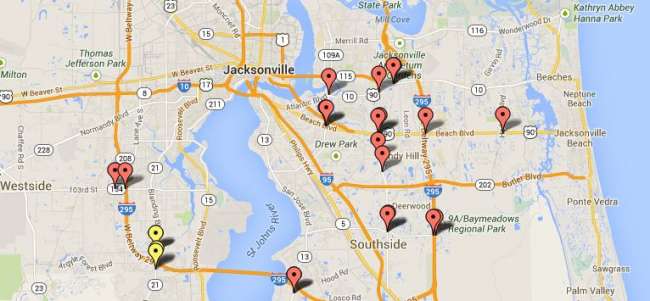
BY THE NUMBERS: Where most red-light violations occur
Now, Aaron Rosenberg, RedFlex’s former top salesman who was fired and sued by the company in the wake of the scandal, has shot back at the company with a counter lawsuit, alleging the company routinely gave gifts and bribes to government officials in attempt to steer contracts. The lawsuit did not elaborate on the bribery accusations, and nobody involved in the controversy has been charged with a crime. Rosenberg’s lawyer has said his client is cooperating with a federal investigation, according to the Chicago Tribune.
MAP: Where the red light cameras are
RedFlex denied Rosenberg’s allegations in a written statement Thursday and vowed to “aggressively defend itself.”
Rosenberg’s lawsuit also mentioned how RedFlex courted Florida government officials with a steak house dinner in Jacksonville. RedFlex invited about 15 council members and their spouses from around the state, including Jacksonville, to dinner at Morton’s Steakhouse in August 2006, according to a series of e-mails included in the countersuit. The dinner cost $3,230.
RELATED: See our traffic page for the latest road conditions, construction and traffic cams
The e-mails do not include the names of who attended the dinner, so it’s not clear if anyone from Jacksonville accepted the invitation. But RedFlex employees discussed in the e-mails how the dinner helped gain the attention of the Jacksonville’s Sheriff’s Office, which would years later pick RedFlex to administer its red-light camera program.
In one e-mail, a RedFlex employee said a meeting with “Jacksonville police and engineering which resulted in the request of a proposal” was a “direct result of the function.” A follow-up breakfast was also scheduled with the “Jacksonville Sheriff, Engineering and County administrator” in December 2006, according to the e-mails.
There isn’t a county administrator position.
Sheriff’s Office spokeswoman Lauri-Ellen Smith said Tuesday in a written statement that Sheriff John Rutherford didn’t recall attending any dinners or breakfast meetings with RedFlex, as mentioned in the lawsuit. Smith also denied that a request for proposal was issued as a result of meetings with RedFlex in 2006.
“The actual award of the contract did not occur until five years later, in 2011, and was the result of a full and open RFP [request for proposal], conforming precisely to the requirements of Florida law and the City of Jacksonville procurement code,” Smith said in her statement.
The city’s interest in red-light cameras dates back to 2007, when the City Council passed a law calling for their installation. However, Florida law did not allow red-light cameras, and the city held off implementing the cameras until the state Legislature passed a law allowing them in 2010.
The city of Jacksonville, along with two companies that unsuccessfully competed for the city’s red-light camera contract, hired lobbyists while lawmakers considered the bill, state records show. American Traffic Systems began lobbying the legislature in 2007, and Xerox Inc., which owns a red-light camera subsidiary company, hired a lobbyist in 2010. One of American Traffic Systems’ lobbyists, Southern Strategy Group, also lobbied for the city of Jacksonville.
RedFlex also hired a lobbyist, but it wasn’t until July 2010, a few months after the governor signed the law allowing red light cameras. That lobbying firm, Tidewater Consulting, was also lobbying at the time for the Jacksonville Sheriff’s Office. Edward Blakely, who was employed by Tidewater at the time, has served as Sheriff John Rutherford’s campaign manager.
Rutherford was an early advocate of the red-light camera program, and the Sheriff’s Office had an instrumental role in choosing which company received the contract.
Blakely did not return phone messages seeking comment.
Council president Bill Gulliford said he would have liked to have known the two entities employed the same lobbyist when he approved the red-light camera contract. He said he doesn’t think the information would have changed the way he voted, but it may have led him or other council members to ask more questions.
“In this day and time, I think, frankly, you should go overboard in the other way as to not give any inkling or picture of anything that could remotely be called impropriety,” Gulliford said.
RedFlex ultimately won a $7.7 million contract with the city and has installed cameras at 25 intersections since 2012. The company will install four more cameras by the end of this month.
read more